Kirlian Photography


The process of Kirlian photography is named after Seymon Davidovitch Kirlian.
He was an amateur inventor and electrician and was born on February 25 of 1898 in the city of Krasnodar, in the South of Russia.
He accidentally discovered a camera that could capture the aura or bio-fields of persons or objects on film.
His initial experiments were simple, with his first experiment he just photographed his hand, noting a strange orange glow radiating from the fingertips.
After noticing this strange phenomena together with his wife and comrade, Valentina Chrisanfovka, they photographed both animate and inanimate objects.
Over the years, they refined their equipment and graduated from black and white to colored photography.
In the late 1940's, the Russians began serious research into the auric field and how it pertains to the physical body.
It wasn't until the 1960's, that Kirlian photography began in the United States.
Kirlian photography uses a high voltage camera which provides a method for converting the non-electrical properties of an object into electrical properties.
These converted electrical fields are then captured on film by means of high-voltage spark discharges.
There is evidence that Kirlian photographs do give indications of the health and emotional changes in living things by changes in the brightness, colour, and patterns of light.
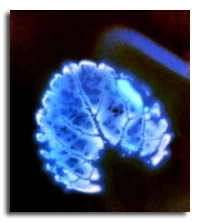

At the University of California Centre for Health Sciences, a plant's leaf showed changes when being approached by a human hand and pricked.
Even when part of the leaf was cut off, the glowing portion of the amputated portion still appeared on film.
Other researchers have found that changes in the emotional conditions of humans can be detected by changes in the brightness, colour and formation patterns in the photographs.
Kirlian Photography is a photographic process that captures the auras or bio-fields of persons or objects within the photograph.
The technique involves the photographing of subjects in the presence of a high-frequency, high-voltage, low-amperage-electrical field, which display glowing, multi-colored emanations known as auras or bio-fields.
When psychic healers and the psychokinetic metal-bender Uri Geller were photographed flares of light were seen streaming from their fingertips as they performed their respective activities.
The science of Kirlian Photography is just one way of seeing the Aura.
Your "Like" & "Vote" would really be appreciated.
Join the HJE Healing Community!
This website is for you and others like you who have a desire to be a part of the natural way to heal.
I am sure you too have found a lot of valuable insights into energy healing and by sharing our knowledge we get to help one another.
This web site is a collation of my knowledge spread over more than 400 pages but I know that there is a lot more information and success stories out there and I would just love to hear about them.
I'd love to receive any articles, photos, stories, reviews, or other content you'd like to share.
Share Your Energy Healing Experience by submitting it right here on this site, then site visitors can read, rate, and comment about it. See an example of how this works with an interesting story of what happend to me about perfection.
You can also share or comment on any page of this website, just see the "Share this page" and "Leave a Comment" options at the very bottom!
Please join me as we develop and grow this fun Healing Community.

There's also an active group of fans on my Healing Journeys Energy Facebook Page so come join the conversation, we'd love to have you with us!

I recently started a Pinterest page with tons of boards to follow!

Of course I am available on Twitter and would love to see your tweets!