What Is Color?


Color comes from the spectrum of light (the dispersion of light energy versus wavelength), as it is reflected or absorbed in other words when light hits an object, some of the wavelengths are absorbed and some are reflected, depending on the materials in the object and the reflected wavelengths are what we perceive as the object's color.
Color is light and most of this light comes from the sun.
This visible light which is part of a wider spectrum of energy that surrounds us, interacts with our eyes which in turn translates the energy of light into signals - nervous impulses - that the brain then interprets as "seeing".
Finally... Color EXPLAINED!
 Reminder
Incredible as it might seem... Color Healing plays an important role in getting and staying healthy...
In "The Color Course - The Diversity of Color Healing" you will learn that just as our bodies need food and water to survive it also needs color or light to balance and energize because color is light and light is an essential nutrient to all life.
Visible light is split into seven wavelength groups vibrating at different speeds and different frequencies.
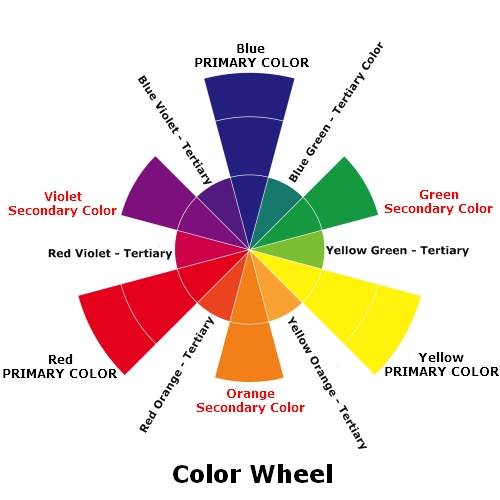
To further explain - the long wavelengths are the reddish colors, the greenish colors are the mid-size wavelengths and the short wavelengths are the bluish colors, see color wheel diagram here.
These wavelenths of energy, to us, appear as color due to the potential and capabilities of objects to either absorb (objects that ABSORB all wavelengths and DO NOT reflect any of these wavelengths, will be seen as black) or reflect (objects that REFLECT all wavelengths in other words reflecting everything, will be seen as white) the energy.
It is between black and white that COLOR lies.
These are the colors you see in a rainbow known by the mnemonic ROYGBIV or in England is most commonly refered to as "Richard Of York Gave Battle In Vain" which references the colors in order i.e. red, orange, yellow, green, blue, indigo, and violet.
Colors affect us in numerous ways and is active on all levels of our being - mental, emotional, physical and spiritual. A strong red color has been shown to raise the blood pressure, while a blue color has a calming effect.
The Effect Of Color
Being able to use colors consciously and harmoniously can help you create spectacular results on all levels. Visualizing and meditation with color is very powerful if it is worked with regularly.
The chemistry of color involves pigments and combinations.
Primary, Secondary and Tertiary Colors

Primary Colors
Primary colors are sets of colors that can be combined to make a useful range of colors. For human applications, three primary colors are usually used and they cannot be made up from any other colors: Blue, Red and Yellow.
Secondary Colors
Each secondary color is made from the two primary colors closest to it on the color wheel and are formed by mixing equal parts of the primary colours as follows: Red + Blue = Violet, Blue + Yellow = Green and Yellow + Red = Orange.
Tertiary Colors
These are formed by mixing a primary colour with a secondary on a ratio of 2 to 1 and are: Blue-Green, Yellow-Green, Yellow Orange, Red-Orange,
Red-Violet and Blue-Violet.
Complementary Colors
These are those which, when mixed together in the same proportion produces grey and are opposite one another e.g. as follows: Red - Green, Violet - Yellow, Blue - Orange. etc.
Warm Colors
Warm colors are vivid and energetic, and tend to advance in space. They tend to make you think of sunlight and warmth and are in the color range of Red, Orange and Yellow.
Cool Colors
Cool colors give an impression of calm, and create a soothing impression. They might make you think of cool and peaceful things, like winter skies and are in the color range Blue, Green and Violet.
Colour plays a primary role in energy healing techniques, as I am sure you are aware your Chakras are represented by the seven major colors and crystals derive a lot of their healing powers from their colors.
Your "Like" & "Vote" would really be appreciated.
Join the HJE Healing Community!
This website is for you and others like you who have a desire to be a part of the natural way to heal.
I am sure you too have found a lot of valuable insights into energy healing and by sharing our knowledge we get to help one another.
This web site is a collation of my knowledge spread over more than 400 pages but I know that there is a lot more information and success stories out there and I would just love to hear about them.
I'd love to receive any articles, photos, stories, reviews, or other content you'd like to share.
Share Your Energy Healing Experience by submitting it right here on this site, then site visitors can read, rate, and comment about it. See an example of how this works with an interesting story of what happend to me about perfection.
You can also share or comment on any page of this website, just see the "Share this page" and "Leave a Comment" options at the very bottom!
Please join me as we develop and grow this fun Healing Community.

There's also an active group of fans on my Healing Journeys Energy Facebook Page so come join the conversation, we'd love to have you with us!

I recently started a Pinterest page with tons of boards to follow!

Of course I am available on Twitter and would love to see your tweets!





Comments
Have your say about what you just read! Leave me a comment in the box below.